
do you need electrolytes every day?
By BodyFlow Hydration·Published October 2026·Last reviewed October 18, 2026
It’s a fair question. Electrolytes are everywhere right now: on drink labels, at the gym, all over social media. So do you actually need them every day?
do you need electrolytes every day?
By BodyFlow Hydration·Published October 2026·Last reviewed October 18, 2026
It’s a fair question. Electrolytes are everywhere right now: on drink labels, at the gym, all over social media. So do you actually need them every day?
your body uses them all day.
Electrolytes help balance the amount of water in your body, move nutrients into your cells and waste out of them, and support your muscles, nerves and steady heart rhythm.[1] That work doesn’t take a day off.
your body uses them all day.
Electrolytes help balance the amount of water in your body, move nutrients into your cells and waste out of them, and support your muscles, nerves and steady heart rhythm.[1] That work doesn’t take a day off.
where they come from.
Electrolytes come from the foods you eat and the fluids you drink.[1] Fruits, vegetables, beans, dairy, nuts and even table salt all contribute. (For a closer look, see sodium, potassium and magnesium.)
where they come from.
Electrolytes come from the foods you eat and the fluids you drink.[1] Fruits, vegetables, beans, dairy, nuts and even table salt all contribute. (For a closer look, see sodium, potassium and magnesium.)
when your balance can shift.
Some days ask more of you. You can lose more fluid than usual when you sweat a lot, exercise or work outdoors in hot weather, or have a fever, vomiting or diarrhea.[3]
Certain medicines and some health conditions can affect your fluid and electrolyte balance too.[1] And as we get older, some of us feel less thirsty, so it’s easier to drink less than we need.[3]
why it isn’t always that simple.
on your plate. Many Americans fall short on some key minerals. In one large national analysis of U.S. diet data, about 45% of people had magnesium intakes below the estimated average requirement, and only about 3% took in more than the adequate intake for potassium.[4]
in your glass. Some home water treatment strips minerals out. Point-of-use reverse osmosis systems and distillers remove virtually all the minerals from the water that runs through them.[5]
in the produce aisle. Researchers who compared U.S. food data from 1950 and 1999 found lower levels of some nutrients, including calcium and iron, across a group of garden crops, likely tied to newer high-yield varieties.[6] How big the change is in any one food is still debated.[6]
simple everyday habits.
It’s important to take in fluids throughout the day.[2] Individual needs vary with sex, weight, age, activity level and health conditions.[2]
Most of the time, choose water over sweetened drinks.[2] And if you’re concerned you’re not getting enough fluids, talk with your health care provider.[2]
where bodyflow fits.
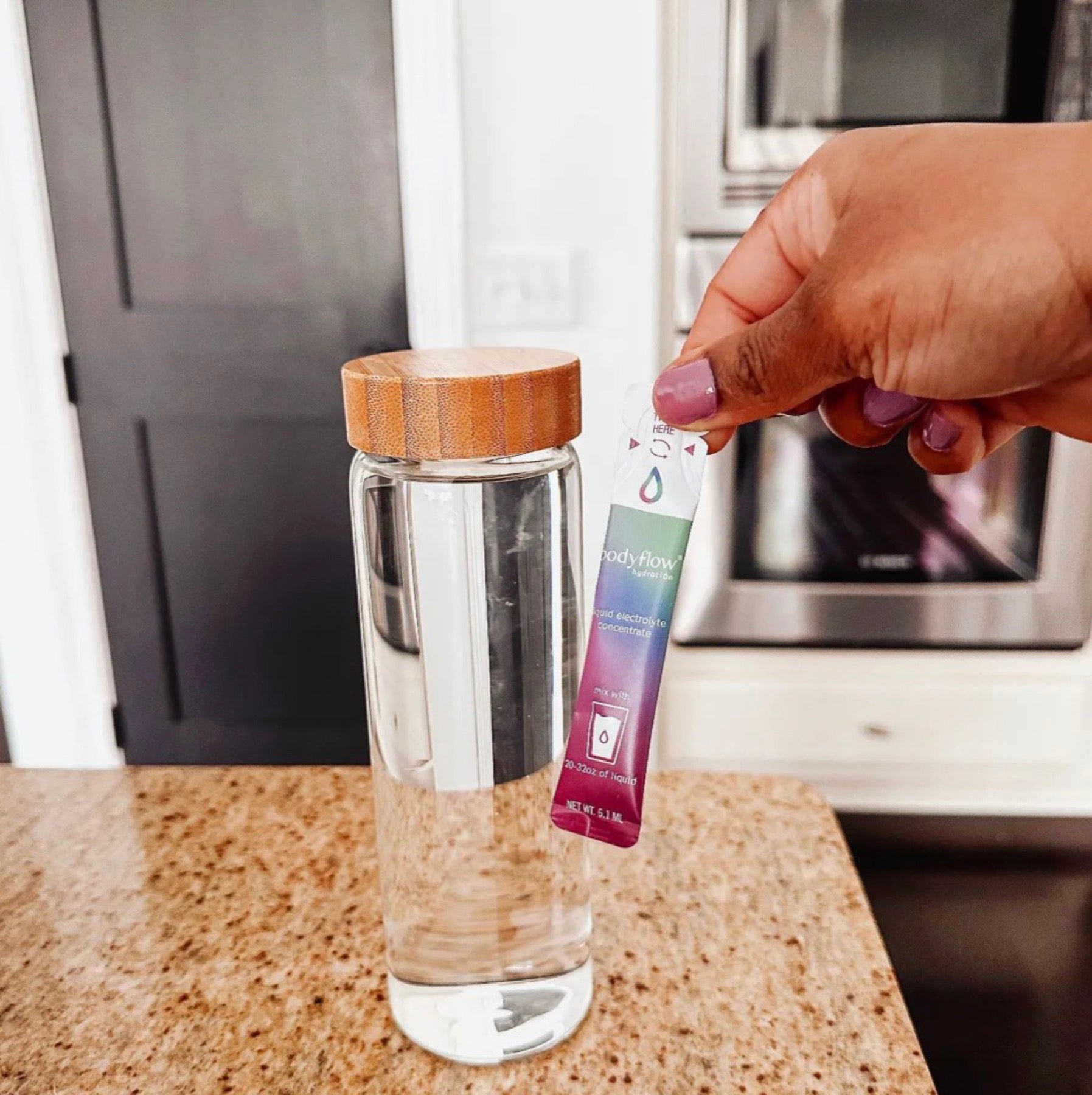
BodyFlow makes hydration one less thing to think about. Just add a stick to the drink you’re already enjoying: three essential minerals, sugar-free and unflavored.
Keep a few sticks in your bag, at your desk or by the sink, so it’s easy to add to your day.
where bodyflow fits.
BodyFlow makes hydration one less thing to think about. Just add a stick to the drink you’re already enjoying: three essential minerals, sugar-free and unflavored.
Keep a few sticks in your bag, at your desk or by the sink, so it’s easy to add to your day.
Curious to keep learning? Start with what are electrolytes?, or meet the three minerals in sodium, potassium and magnesium.
We write to inform, not to diagnose. If you have a medical condition, talk with your clinician about your hydration.
Curious to keep learning? Start with what are electrolytes?, or meet the three minerals in sodium, potassium and magnesium.
We write to inform, not to diagnose. If you have a medical condition, talk with your clinician about your hydration.
references
- MedlinePlus (National Library of Medicine). Fluid and Electrolyte Balance. https://medlineplus.gov/fluidandelectrolytebalance.html
- MedlinePlus Medical Encyclopedia. Water in diet. https://medlineplus.gov/ency/article/002471.htm
- MedlinePlus (National Library of Medicine). Dehydration. https://medlineplus.gov/dehydration.html
- Fulgoni VL 3rd, Keast DR, Bailey RL, Dwyer J. Foods, fortificants, and supplements: where do Americans get their nutrients? Journal of Nutrition. 2011;141(10):1847–1854. (NHANES 2003–2006 data.) https://pubmed.ncbi.nlm.nih.gov/21865568/
- World Health Organization. Hardness in Drinking-water: background document for the WHO Guidelines for Drinking-water Quality. 2011. https://cdn.who.int/media/docs/default-source/wash-documents/wash-chemicals/hardness-bd.pdf
- Davis DR, Epp MD, Riordan HD. Changes in USDA food composition data for 43 garden crops, 1950 to 1999. Journal of the American College of Nutrition. 2004;23(6):669–682. https://pubmed.ncbi.nlm.nih.gov/15637215/
Sources accessed October 18, 2026.
ready to try it?
30 liquid sticks · unflavored · sugar-free
shop bodyflow